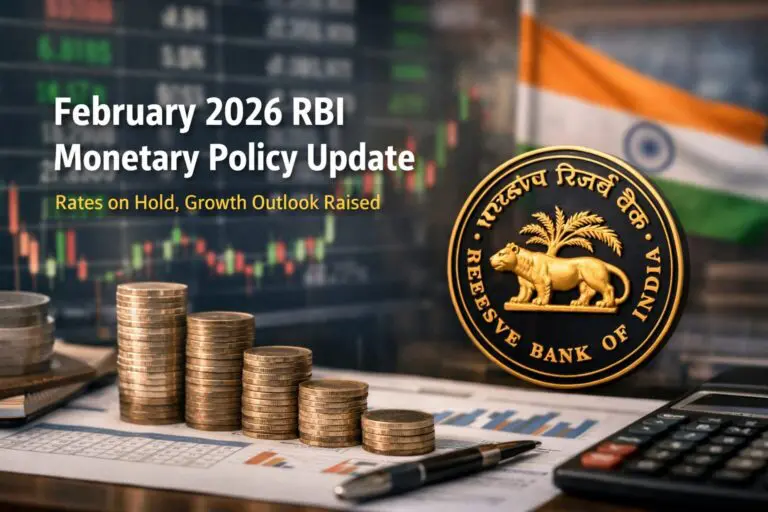
The RBI Repo Rate 2026 decision is being closely watched by banks, investors, and borrowers across India. With inflation trends stabilizing and global economic uncertainty continuing, the Reserve Bank of India (RBI) faces a critical choice — whether to cut, hold, or increase the repo rate.
The repo rate is the interest rate at which the RBI lends money to commercial banks. Any change directly impacts loan EMIs, home loan rates, and overall liquidity in the economy.
What Is the Repo Rate?
The repo rate is a key monetary policy tool used by the RBI to control inflation and manage economic growth. When the RBI increases the repo rate:
- Loan interest rates rise
- EMIs become more expensive
- Inflation slows down
When the RBI cuts the repo rate:
- Loans become cheaper
- EMIs reduce
- Spending and investment increase
The RBI Repo Rate 2026 decision will depend heavily on inflation data and GDP growth numbers.
Why RBI Repo Rate 2026 Is Important
In 2026, India’s economy is balancing growth momentum with inflation management. A rate cut could boost:
- Housing demand
- Auto sales
- Business expansion
- Consumer spending
However, if inflation pressures rise, the RBI may choose to maintain or even increase rates to ensure price stability.
Financial experts believe that global crude oil prices and US Federal Reserve decisions will also influence the RBI Repo Rate 2026 outcome.
Impact on Home Loan EMIs
If the RBI reduces the repo rate in 2026:
- Home loan EMIs may decrease
- Personal loans could become cheaper
- Real estate demand may rise
On the other hand, a rate hike could increase monthly repayment burdens for borrowers.
Borrowers with floating interest rate loans are especially sensitive to repo rate changes.
- Personal loans could become cheaper
- Real estate demand may rise
On the other hand, a rate hike could increase monthly repayment burdens for borrowers.
Borrowers with floating interest rate loans are especially sensitive to repo rate changes.
What Experts Expect
Market analysts suggest the RBI may adopt a cautious approach. If inflation remains within target range, a small rate cut could support growth. However, if external risks increase, the central bank may hold rates steady.
The final decision will be announced after the Monetary Policy Committee (MPC) meeting.
Conclusion
The RBI Repo Rate 2026 decision will play a crucial role in shaping India’s economic direction. Whether it results in a rate cut or hike, the impact will be felt across sectors — from housing and banking to stock markets and small businesses.
Borrowers and investors should closely track the upcoming RBI policy announcement.
ನಿಮ್ಮದೊಂದು ಉತ್ತರ Elon Musk Moon City: Self-Growing City on the Moon in 10 Years? ಗಾಗಿ ಪ್ರತ್ಯುತ್ತರವನ್ನು ರದ್ದುಮಾಡಿ